
Planning your move? Here’s the honest answer to the Spain digital nomad visa timeline question everyone asks before they apply. The Spain Digital Nomad Visa (DNV) itself gets processed fast. But your total timeline depends on one thing above all: how fast you get your documents apostilled and translated. And that happens before you even submit your application.
Most delays people blame on “slow Spanish bureaucracy” actually happen before the file is filed at all.
So let’s walk through the realistic Spain digital nomad visa timeline for 2026, route by route. That way, you can plan backward from your target move-in date instead of just guessing.
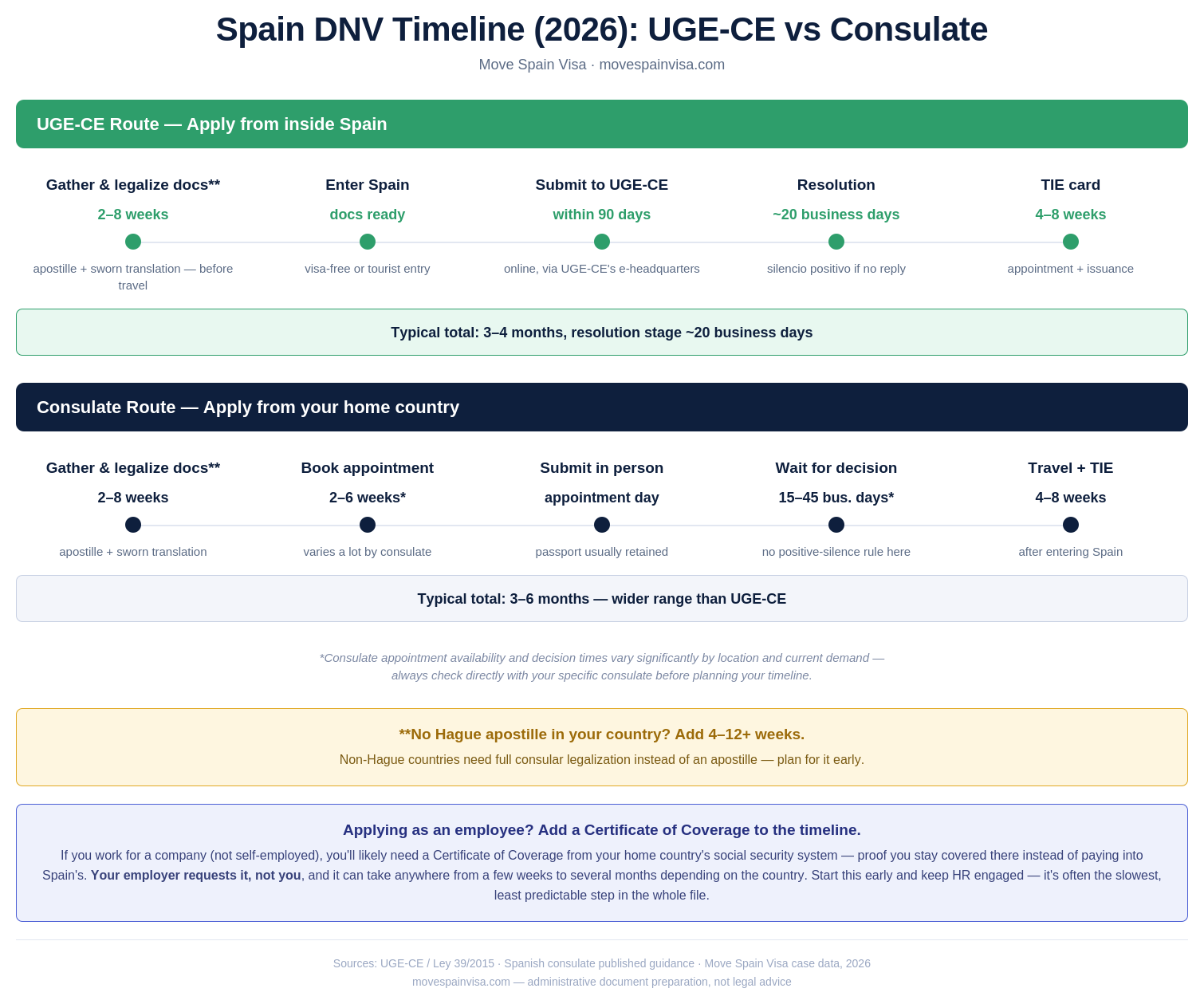
Two Routes, Two Very Different Spain Digital Nomad Visa Timelines
You can request the DNV in two ways. And the route you pick changes both your waiting time and the permit you walk away with.
| Route | Where you apply | Official processing time | Permit granted |
|---|---|---|---|
| UGE-CE (in-country) | Online, from inside Spain | 20 business days (statutory) | 3-year residence authorization |
| Consulate (abroad) | Spanish consulate in your home country | 15–45 business days | 1-year entry visa |
Understanding the UGE-CE Silencio Administrativo Rule (and Its Effect on Your Timeline)
The UGE-CE route has a nice safety net: silencio administrativo positivo. If 20 business days pass with no reply, the law treats your application as approved. In practice, most 2026 cases resolve in 16–18 business days, as long as the file is complete the first time around.
Consulate Route: How It Changes Your DNV Timeline
The consulate route doesn’t offer that same safeguard. And the real bottleneck usually isn’t the processing itself — it’s getting an appointment. That alone can add 2 to 6 weeks before you even submit anything.
One thing trips people up here. You can’t switch from a Non-Lucrative Visa, tourist entry, or any other non-work status into a DNV from inside Spain. If that’s your situation, apply at a consulate abroad instead. Want the full picture of what causes rejections at this stage? Check our DNV Rejection Reasons guide.
The Phase Nobody Talks About in Your Spain Digital Nomad Visa Timeline: Document Prep
Here’s the part most guides skip. Whichever route you choose, the visa clock only starts once your file is complete. For most applicants, gathering apostilled and translated documents actually takes longer than the visa decision itself.
Why? Any foreign document you submit needs to be legalized for use in Spain. Think background checks, birth or marriage certificates, proof of company registration. If your document comes from a Hague Convention country — the US, UK, Canada, Australia, Ireland — that means an apostille. Then a certified sworn translation into Spanish. Each step has its own processing queue. Neither one is something Spain controls.
Realistic Document Prep Timelines Behind Your Spain Digital Nomad Visa Timeline
Here are realistic ranges for 2026:
- Apostille turnaround: anywhere from a few business days to 8 weeks, depending entirely on the issuing state or country. Some US state offices process apostilles in days. Others, especially during busy periods, can take a month or two with standard service.
- Sworn translation: typically 2–5 business days per document, once you have the apostilled original in hand.
- Employer or client cooperation: if part of your file depends on a letter, contract, or payslip, this can quietly become your slowest step. A responsive employer turns it around in days. A slow HR department or an unresponsive client can stall you for weeks, and there’s not much you can do about it in the meantime.
- Certificate of Coverage (employees only): if you’re a W-2 or PAYE-style employee rather than self-employed, you’ll likely need to prove you stay covered by your home country’s social security system instead of Spain’s. Timelines vary a lot by country and are largely out of your hands — plan for it early rather than assuming it’ll sort itself out quickly.
Certificate of Coverage: The Wildcard in Your Visa Timeline
Applying as an employee? Budget extra time for the Certificate of Coverage.
If you’re employed (not self-employed) and your home country has a social security agreement with Spain, you’ll typically need a Certificate of Coverage — the document that proves you remain covered under your home system so you’re not double-paying into Spain’s. The catch: in most cases your employer has to request it, not you. Turnaround varies widely by country and can run anywhere from a few weeks to several months, and it’s genuinely one of the least predictable steps in the whole process. This is yet another reason to loop your employer in early and keep the pressure on gently but consistently — a file that’s otherwise ready can still sit waiting on this one document.
Non-Hague Countries: How Legalization Extends Your Timeline
Does your document come from a non-Hague country? Then the apostille shortcut won’t work for you. It only applies to the 1961 Hague Convention’s member countries. Instead, your documents need full consular legalization: notarization, then state or national authentication, then legalization at the Spanish embassy or consulate in that country. That chain commonly adds another 4 to 12 weeks on top of everything else. In trickier cases, it can stretch closer to 16 weeks. Most US, UK, Canadian, Australian, and Irish documents skip this entirely. Still, check your specific country’s status before assuming a standard apostille timeline applies to you.
Expedited Services: Shortening Your Spain Digital Nomad Visa Timeline
This is the phase where timelines quietly fall apart. It’s also the one place where a fast-track service genuinely changes your total timeline, not just your comfort level. We coordinate this step with Tu Apostilla’s expedited service. They offer expedited apostille and sworn-translation service for US and Canadian applicants, built specifically for Spanish immigration use. That shaves weeks off the standard timeframes above. It matters most if you’re already inside Spain, racing your 90-day window.
One advantage worth flagging: the apostille itself only works between Hague member countries. But Tu Apostilla’s certified sworn translators cover every country and language. So even if your background check goes through consular legalization instead of an apostille, translation still won’t be your bottleneck.
Fingerprinting: A Step That Can Quietly Delay Your Timeline
Fingerprinting is another step people often forget to plan for, especially if you’re applying for an FBI or RCMP background check. As an authorized Tu Apostilla partner, I personally handle in-house fingerprint capture for both here in Murcia. If you’re in or near the area, come see me directly and I’ll take your prints on the spot. If you’re elsewhere in Spain, just get in touch and we’ll point you to the closest option.
Want the full list of what needs apostilling and translating before you file? Check our Documents Checklist.
Should You Travel to Spain Before Your Documents Are Ready? (Timeline Risks to Know)
Our honest recommendation: no, not unless you’ve specifically researched fast-track options and budgeted for them. Try to have your documents as close to ready as possible before you travel.
Here’s why it matters so much. If you’re entering on a 90-day visa-free stay, that clock starts the moment you land. Every week you spend waiting on an apostille or a translation is a week you’re not applying to the UGE-CE. Some applicants do land with translations still pending. That only works if their apostilled documents are already in hand, and Spain’s translation turnaround is running fast and predictable. If your entry window is shorter than 90 days, we wouldn’t recommend even that.
Handling any of this from inside Spain? Go in knowing it usually means paying for expedited service, not standard processing. The timelines above assume you’re not racing a visa clock.
Sequencing Documents to Protect Your Visa Timeline
Once you know which documents you need, sequence them by how long they stay valid. Don’t sequence them by how easy they are to get:
- Start with your longest-validity documents first. Think FBI or RCMP background checks and degree certifications, which some Spanish offices accept for up to 6 months from issue. Getting these moving early absorbs the slowest apostille queues without creating pressure later.
- Leave short-validity documents for last. Proof-of-funds statements or recent payslips are often only accepted if dated within 30 days of submission. Order these too early, and you’ll just end up re-issuing them.
- Flag anything that needs an apostille, right away. Apostille turnaround is the one variable most applicants don’t research until it’s already slowing them down. Check your issuing state or country’s current processing time before you order anything — it can save you weeks.
Here’s one genuine advantage of the DNV worth knowing: for most of the file, digitally signed copies are accepted. You don’t need to wait for physical documents to travel by courier. Your background check, degree, or employer letter might qualify for a valid digital signature. If so, that step alone tends to move much faster than the paper version.
Putting It All Together: A Realistic Spain Digital Nomad Visa Timeline
Most applicants underestimate the total by focusing only on the “20 business days” figure. Here’s what the full Spain digital nomad visa timeline typically looks like in 2026:
| Phase | Typical duration |
|---|---|
| Gathering documents (contracts, proof of income, background check) | 1–3 weeks — longer if it depends on a slow employer or client |
| Apostille + sworn translation | 2–8 weeks with standard service; +4–12 weeks extra if your country isn’t a Hague Convention member; shorter with an expedited/fast-track provider |
| Certificate of Coverage (employees only) | A few weeks to several months, depending on your country’s social security authority — runs in parallel with the above, but can end up the slowest single item if your employer is slow to request it |
| Consulate appointment wait (if applying abroad) | 2–6 weeks |
| Visa/authorization processing | 15–45 business days (consulate) / ~20 business days (UGE) |
| Travel + empadronamiento + TIE appointment and issuance | 4–8 weeks after arrival |
Add it all up, and most people are looking at 3 to 6 months from “I’ve decided to do this” to actually holding a TIE card. That’s true whether they go through the consulate or the UGE-CE. The UGE-CE route is faster on the government’s side, but it doesn’t erase the document-prep phase. It just means you’re doing that prep while already in Spain, on your 90-day entry window. And that raises the stakes if anything gets delayed.
How to Avoid Delays That Blow Up Your DNV Timeline
Almost every timeline blowout we see traces back to one of three things. Starting the apostille process too late. Submitting income documentation that doesn’t match the current income threshold. Or an incomplete file that triggers a requerimiento (a formal request for more documents) — that alone can add 1–3 weeks. None of these come down to luck. They come down to sequencing.
FAQ: Your Spain Digital Nomad Visa Timeline Questions Answered
Can I speed up the UGE-CE processing time?
Not directly — the 20 business day window is set by law. What you can control is submitting a complete file the first time, since a requerimiento is what actually adds weeks.
Does the DNV timeline change during summer or year-end?
Yes. July–August and November–December tend to run slower across both routes, thanks to higher volume and staff holidays. If your timeline is flexible, January through May tends to be more predictable.
Should I enter Spain before my documents are fully ready?
Generally, no. Try to have documents as close to complete as possible before you travel. Your 90-day window starts the moment you land, and every week spent finishing paperwork inside Spain eats into your buffer. Sequencing matters too: gather your longest-validity documents (background checks, degree certifications) first, and save short-validity ones (recent payslips, proof of funds) for last.
Do I need the apostille and translation before booking my consulate appointment?
You need them ready before your appointment date, not before booking it. So book the appointment as soon as you know your date. Then use that lead time to finish document legalization, instead of waiting around.
I’m an employee, not self-employed — does that change my timeline?
Often, yes. Employees typically need a Certificate of Coverage from their home country’s social security system, and that request has to come from your employer, not you. It’s not tied to either the UGE-CE or consulate track specifically, but it runs on its own clock — anywhere from a few weeks to several months — so it’s worth starting the conversation with HR as early as possible, well before you touch the rest of your paperwork.
What happens if my file triggers a requerimiento?
A requerimiento is a formal request for more documents, and it typically adds 1–3 weeks to your timeline while you gather and submit what’s missing. The best way to avoid one is to submit a complete file the first time — see our DNV Rejection Reasons guide for the most common triggers.
Not sure which route fits your situation?
Take the free 2-minute eligibility test and get a clear next step.
Start My Free Eligibility Test →
Prefer to talk it through directly? Book a free consultation instead.
This article is for informational purposes and does not constitute legal or tax advice. Move Spain Visa provides administrative document preparation and consultancy services; complex legal matters are handled in coordination with our partner immigration lawyer. Income thresholds are indexed to Spain’s SMI and may change during the year — always verify current figures before applying.